Moonshot
 Higgsfield
 Orgn
 42dot
 Robocore

Why Lunar Industry Matters Before Mars Settlement
Mars settlement needs industry that can sustain itself. The Moon is close enough to build mining, construction, power, and autonomy before we rely on them farther out.
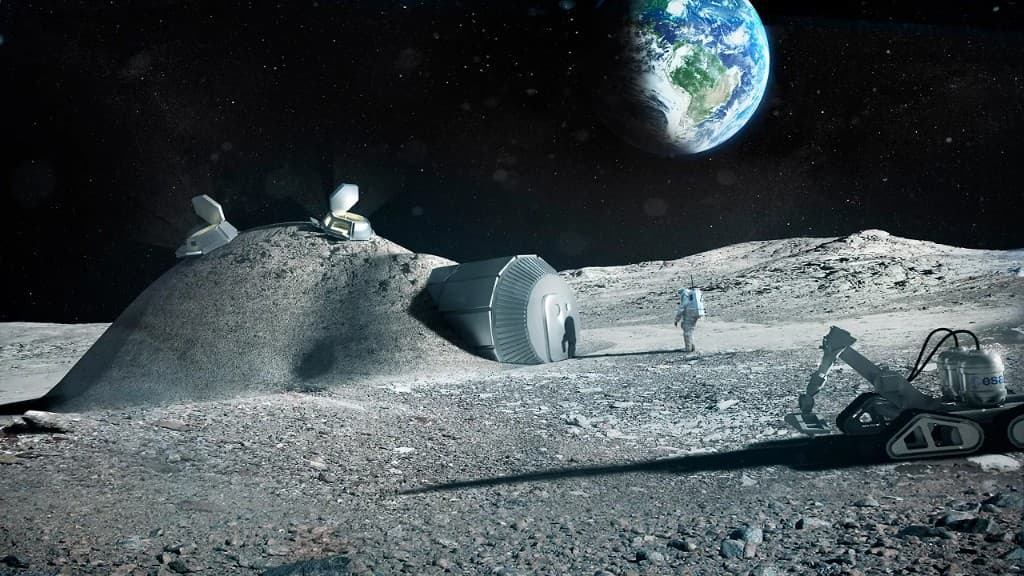
The Companies Building a Lunar Industry
Mars settlement will require an economy capable of supporting itself, and the Moon is where we can begin developing the technologies, infrastructure, and industries needed to make that possible. Establishing a permanent human presence on another world will require much more than spacecraft and habitats. People will need energy, construction materials, transportation, manufacturing, food production, and equipment that can be repaired without waiting for supplies from Earth.
The Moon offers a nearby place to begin building these capabilities. Its surface presents serious challenges, including extreme temperatures, radiation, abrasive dust, and long periods without sunlight. But these conditions also make it a valuable place to test the systems that future settlements will depend on. A growing number of private companies are already working on lunar mining, construction, transportation, and power generation. Their work points toward a future in which the Moon becomes an industrial base rather than simply a destination for scientific missions.
Several startups are working on technologies that could support commercial activity on the Moon. One particularly interesting company is Interlune, a Seattle-based startup developing equipment to extract resources from lunar soil. Its initial focus is helium-3, a rare isotope that accumulates in the Moon’s surface material through billions of years of exposure to the solar wind.
Interlune is developing excavation equipment capable of collecting and processing large quantities of lunar soil. Its approach involves digging into the surface, separating different particle sizes, and extracting gases trapped in the material. The company has also partnered with Astrolab to integrate its excavation equipment onto the FLEX lunar rover. This could allow mining equipment to travel across the surface rather than remain confined to one location. In May 2026, NASA awarded Interlune a $6.9 million contract to develop technology for prospecting and extracting lunar resources. The company is targeting a future demonstration mission to test these capabilities.
Another company working on the physical infrastructure needed for lunar operations is Astroport Space Technologies, based in Texas. Its work focuses on using lunar soil, known as regolith, to construct landing pads, roads, and other infrastructure. One of its technologies involves processing and melting lunar soil to produce solid construction materials. This could help create landing surfaces that prevent rocket exhaust from scattering dangerous dust and debris across nearby equipment. Astroport is also developing robotic construction systems that could prepare sites and build structures without requiring astronauts to perform the work manually.
Astrolab is developing the FLEX rover, a vehicle designed to transport cargo, equipment, and eventually astronauts across the lunar surface. Its mobility systems could support mining operations, construction projects, and transportation between different facilities. The company is also developing a crewed version of its rover. In October 2026, NASA reported that Astrolab was among the companies developing lunar terrain vehicles for future Moon Base operations.
Power is another major challenge. Zeno Power, a Seattle-based company, is developing radioisotope power systems that can generate electricity continuously without relying on sunlight. This matters because the lunar night lasts roughly two weeks, during which solar panels cannot generate electricity. Batteries alone may not be sufficient to keep equipment operating for extended periods. Zeno completed a major design review for its space nuclear battery in April 2026, advancing a system intended to support future lunar missions.
These companies are working on different parts of the same larger problem. Mining equipment needs transportation. Construction requires materials and power. Rovers need energy and maintenance. As these services develop, they could begin supporting one another and create the foundations of a commercial lunar economy.
Mining the Moon for Useful Resources
One of the biggest obstacles to permanent settlements is the cost of transporting supplies from Earth. Every kilogram of equipment, construction material, or fuel must be launched into space and delivered to its destination. Building a settlement that depends entirely on imported supplies would be extremely expensive.
This is why extracting resources locally matters. The Moon contains water ice, particularly in permanently shadowed regions near its poles. That water could be processed into drinking water and separated into hydrogen and oxygen. Oxygen would support life-support systems, while hydrogen and oxygen could potentially be used as rocket propellant.
Lunar soil also contains oxygen chemically bound within minerals. With the right processing equipment, it may be possible to extract that oxygen and use it to support human operations. The soil contains metals such as iron, aluminum, and titanium that could eventually provide raw materials for construction and manufacturing.
Helium-3 is another resource attracting commercial interest. Interlune and other startups are investigating ways to extract it because of its potential uses in specialized applications, including cooling quantum computers. It is also frequently discussed as a possible fuel for future fusion reactors. However, commercial helium-3 fusion power remains a long-term possibility rather than an established energy source.
The larger opportunity is that lunar mining could eventually supply materials for lunar operations and perhaps other destinations in space. Rather than shipping every construction component from Earth, future facilities could process local materials into building products, shielding, and replacement parts.
The Moon as a Practice Field for Mars
The Moon is much closer to Earth than Mars, making it a practical place to test equipment and learn how to operate a settlement beyond our planet. A trip to the Moon takes days, while a journey to Mars generally takes several months. This difference makes it easier to send replacement equipment, conduct experiments, and respond to problems during early lunar operations.
The Moon also provides an opportunity to test autonomous systems. Mining machines and construction robots will need to operate with limited human supervision. Communication delays and the difficulty of controlling every machine remotely make autonomy important. These same capabilities will be needed on Mars, where communication with Earth can take several minutes each way.
There are other technologies that can be tested on the lunar surface. Habitats will need to protect occupants from radiation and extreme temperatures. Life-support systems must recycle water and maintain breathable air. Food production will need to take place in controlled environments, while power systems must operate reliably in a harsh setting.
Perhaps most importantly, future settlements will need the ability to maintain themselves. Equipment will eventually break, components will wear out, and replacement supplies may be months away. Learning to repair machinery, manufacture parts, and process local materials on the Moon could provide valuable experience before attempting the same tasks on Mars.
The two environments are not identical. Mars has a thin atmosphere and different temperatures, while the Moon has virtually no atmosphere and experiences much longer periods of darkness. Still, many of the industrial and operational challenges are shared.
From Exploration to a Space Economy
A permanent lunar presence could create demand for an entirely new range of commercial services. Companies will need to provide transportation, communications, construction, energy, mining, and equipment maintenance. As more infrastructure becomes available, additional businesses could begin operating there.
This is similar to how industries develop in growing regions on Earth. A new industrial facility creates demand for suppliers, transportation, maintenance, and other services. Over time, businesses begin supporting one another. A lunar mining company might purchase transportation services from a rover operator and construction equipment from another company. Those businesses would then need power, communications, and maintenance.
NASA and other government space programs can help create the initial demand by funding missions and purchasing services from private companies. As technology improves and launch costs decline, commercial activity could expand beyond government-funded exploration.
The long-term opportunity is much bigger than establishing a research station. Lunar infrastructure could support manufacturing, resource processing, and eventually the production of supplies for missions traveling deeper into space.
Building the Foundation for Mars
Mars settlement will depend on our ability to build and maintain infrastructure far from Earth. We will need systems that can generate power, extract resources, manufacture useful materials, and keep equipment running with limited outside support.
The Moon gives us an opportunity to develop those capabilities much closer to home. The companies now working on lunar mining, construction, transportation, and energy are tackling problems that will become increasingly important as humanity expands its presence beyond Earth.
A future Mars settlement will need more than rockets capable of delivering people to the surface. It will need an industrial foundation that allows those people to live and work there over the long term. Building that foundation on the Moon could be one of the most important steps toward making Mars settlement possible.
Sources
Published: Oct 20, 2026 · Evan Sipplen